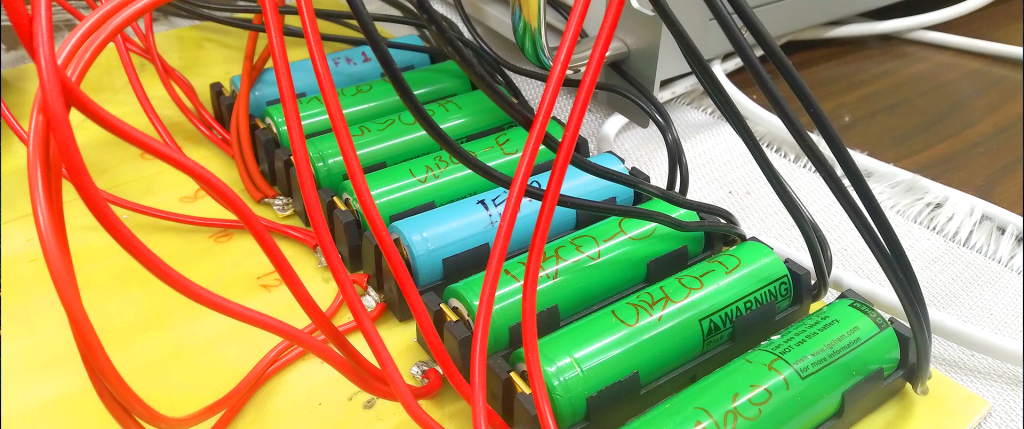
Technology
Go to topics on this page > Further Research > Innovation
Science-based accurate measurement
Industry is currently experiencing extensive wastage of batteries through premature retirement due to inaccurate measurement of their state of health (SoH) and state of charge (SoC). While accumulation of error is a problem for measuring SoC over long periods of time for some applications, it is poor measurement of SoH that leads to early replacement of batteries, which leads in turn to waste and pollution.
The Waikato Battery Team is building a battery management system BMS that addresses these problems and provides reliable data based on scientifically proven accuracy. The team’s cutting-edge technology is based on established electrochemical theory, including advanced signal processing and equivalent-circuit models containing so-called ‘fractional’ or ‘constant-phase’ elements (CPEs) that can accurately measure and predict SoC and SoH of rechargeable batteries. The new technology will provide battery users with precise indicators of when any particular battery will require replacement.
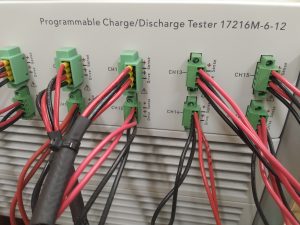
Battery characterization and modelling research were started at the University of Waikato in 2014 by Professor Jonathan Scott and his then-PhD student Rahat Hasan. By 2019, a laboratory and a metrology system providing novel insights had been established. By 2024, the research group included several academic researchers and international experts, as well as PhD and Masters students.
The research team published the various parts of their findings in ten peer-reviewed articles in leading journals covering the fields of electronic engineering, physics and electrochemistry. We now seek to test the technology and develop our research further to move from the laboratory to industry and to make the urgently needed transition to commercialization.
Further Research
The research team is investigating further usage of their discovery. For example – the measurement technology is expected to be relevant to multiple battery types. They incorporate temperature dependence in models and demonstrate reliable real-time in-situ data reduction.
Innovation
The Team’s key product is based on the ability to predict accurately state of charge (SoC) and state of health (SoH) from measurements of battery current and voltage. The knowledge underpinning this technology and of what is inside a battery from an electronic engineering viewpoint has come from a novel and powerful measurement system.
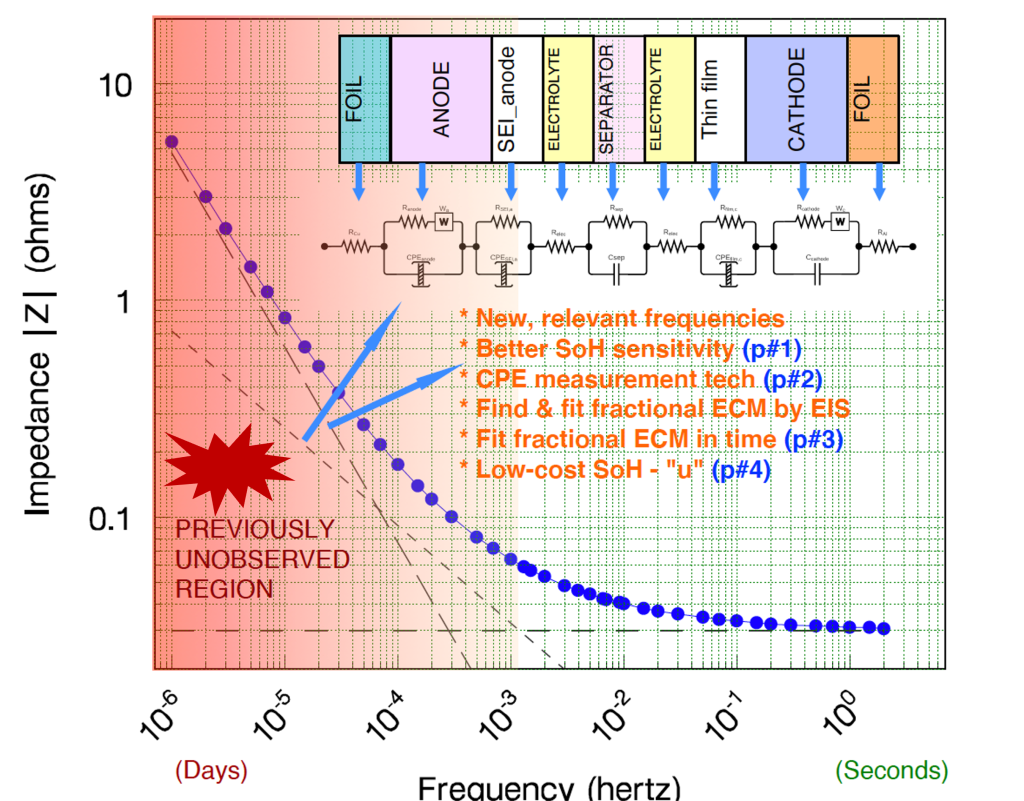
The novelty lies in leading-edge developments in extra-low frequency characterization (i.e., measurements taken over very long timescales that are representative of the usage cycles of batteries in the real world), identification and computation of equivalent-circuit models containing CPEs, and powerful new data-fitting algorithms. These will revolutionize BMSs and battery quality assessment. CPEs are circuit elements that are now known to represent accurately the energy storage and release characteristics of batteries. They can be viewed simplistically as resembling ‘leaky capacitors’, and their behavior is described mathematically by fractional calculus. This enables us to equip our battery models with the CPE components required for realistic characterization and prediction, to identity hallmarks of aging and degradation, and to provide timely warning of need for replacement to users.